
Once overlooked as a basic hygiene task, oral care is now experiencing a glow-up—emerging as the next big trend in personal wellness, much like skincare did years ago. With advances in smart technology, aesthetic packaging, and social media influence, brushing your teeth is no longer a chore—it’s a ritual. Like skincare, modern oral care is now about prevention, personalization, and daily consistency. With tools like BrushO, oral hygiene is evolving into a beauty and health statement.
Skincare evolved from “washing your face” to a multi-step, mindful ritual with cleansers, toners, serums, and moisturizers. Why? Because people realized that consistent, intentional care could preserve youth, prevent damage, and enhance confidence.
• Cleansing = Brushing
• Toning = Rinsing / Tongue Scraping
• Serum = Whitening / Desensitizing products
• Moisturizing = Saliva-stimulating or hydration-focused routines
Oral care is moving beyond ‘just brushing’ into self-care—and the market is responding.
A radiant smile is now as important as clear skin. In the age of selfies and Zoom calls, oral aesthetics matter.
Much like skincare, oral care has become shareable content: “What toothbrush do you use?” “What’s your whitening routine?” “How do you get fresh breath all day?”
People now seek routines that make them feel good, not just look good. Brushing is becoming part of morning and nighttime wellness rituals.
Just as skincare relies on skin type and sensitivity, oral care is moving toward customized brushing routines, real-time feedback, and data tracking.
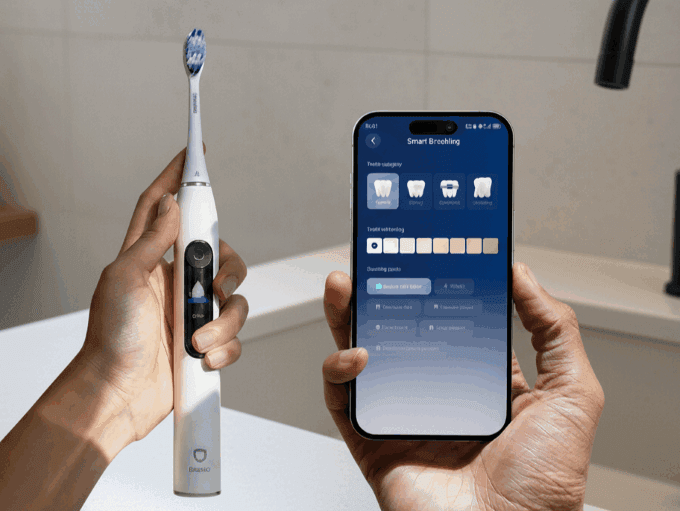
Like upgrading from a drugstore cleanser to a smart serum, BrushO is your next-gen upgrade for brushing. Here’s how it brings skincare-level luxury and effectiveness to your mouth:
Smart sensors analyze your brushing style, pressure, and coverage. Get feedback tailored to your needs.
Daily brushing reports help build consistency—just like skincare journaling or app reminders.
Whitening mode, sensitive mode, deep clean—choose based on your “oral skin type.”
BrushO doesn’t just clean—it supports long-term health and visible beauty.
Modern design meets high-tech elegance—because like skincare bottles, toothbrushes now sit proudly on the vanity.
Just as a skincare routine may include cleansing, treating, and moisturizing, your oral care ritual should be layered too:
1. Brush with intention (2 minutes, all zones)
2. Use a smart toothbrush for accurate pressure and coverage
3. Clean your tongue to fight bad breath
4. Rinse or floss to complete the cleanse
5. Stay consistent morning and night
Oral care is no longer just about preventing cavities—it’s about feeling fresh, looking confident, and embracing wellness. Just like skincare, your brushing routine should reflect who you are, what you value, and how you care for yourself. With smart devices like BrushO, you’re not just cleaning your teeth—you’re creating a daily ritual of beauty, precision, and self-respect. Because your mouth deserves as much love as your skin. BrushO is an AI-powered smart toothbrush designed to bring precision, personalization, and pleasure to oral care. With real-time brushing feedback, habit tracking, multiple brushing modes, and $BRUSH token rewards, BrushO transforms your daily brushing into a self-care ritual that fits your lifestyle and your smile.

Saliva has moved from the byproduct of the examination to the fluid that the modern practice can read, and the diagnostics that the salivary sample supports now reach from the caries risk to the periodontal inflammation and beyond. The fluid is easy to collect, safe to handle, and rich in the pro...

The narrow alveolar ridge is the common obstacle that the implant plan meets in the healed posterior site, and the ridge split technique is the approach that widens the crest without the block graft and the second surgical site. The technique uses the viscoelastic property of the bone, and the co...

The resin-bonded bridge is the conservative alternative to the conventional fixed prosthesis, and its place in the modern practice has widened as the adhesive dentistry matured. The prosthesis replaces the missing tooth with the minimal removal of the enamel from the abutment, and the retention i...

The systemic antibiotic has a defined and a narrow place in the periodontal therapy, and the clinician who respects its limits uses it well while the clinician who reaches for it routinely erodes both the result and the antibiotic stewardship. The mechanical debridement remains the foundation of ...

The bond failure of the bracket is the interruption that the fixed orthodontic treatment can tolerate in the small number but not in the pattern, and the clinician who understands the cause reduces the frequency that the repeated rebonding records. The failure that recurs on the single tooth poin...

The prescription pad is one of the most common sources of the oral complaint that the patient brings to the dental office, and the clinician who does not think of the medication may spend the appointment treating the symptom that the drug created. The list of the agents that affect the mouth grow...

The intraoral scanner has moved from the novelty of the early adopters to the standard equipment of the modern prosthodontic practice, and the comparison with the conventional impression has become a daily question rather than an academic one. The scanner captures the surface of the teeth and the...

The endodontic retreatment is the second chance that the tooth receives when the initial treatment fails to resolve the infection or the symptoms, and the procedure is both more demanding and more rewarding than the primary treatment. The clinician who retreats the tooth encounters the filling ma...

The access preparation is the gateway of every root canal treatment, and it is the step at which the outcome of the case is most often decided, for good or for ill. A well-designed access straightens the canal system, removes the coronal obstruction, and allows the instruments and the irrigants t...

The restoration that the laboratory returns is only as good as the information that the clinician sends, and the communication between the dentist and the technician is the step that determines whether the crown, the veneer, or the bridge meets the expectation of the patient. The shade, the form,...

Construa uma rede de dados de saúde bucal rapidamente e com baixo custo de forma que todos possam construir.
Construa uma rede de dados de saúde bucal rapidamente e com baixo custo de forma que todos possam construir.


Address: RM 1427, 14/F RADIO CITY 505, HENNESSY RD CAUSEWAY BAY, HONG KONG
Code: 000000
Phone: +852-53758652
Email: customerservice@brusho.com