
In a world overloaded with routines, tools, and self-care steps, many people are embracing minimalism—including in oral hygiene. Instead of multi-step, complicated regimens, today’s users are choosing smarter, simpler, and more intentional oral care routines. This new approach doesn’t mean doing less; it means doing better with less. Powered by smart technology and guided brushing, minimalist oral care is proving to be just as effective—and even more sustainable.
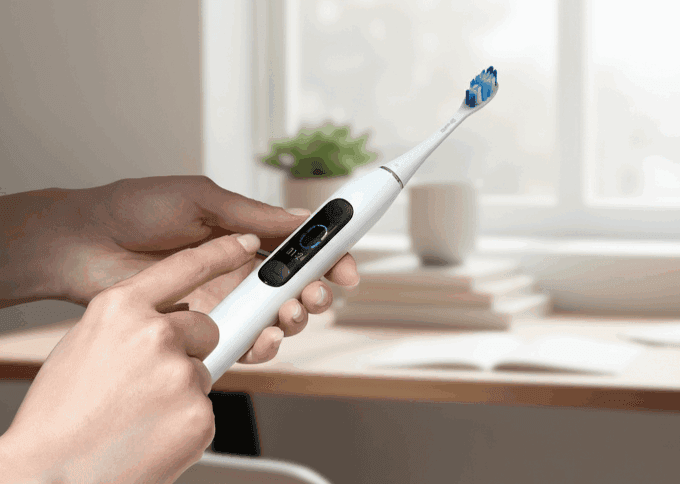
Minimalism is no longer just about decluttering your home. It’s a mindset that’s influencing how people approach wellness routines:
• Fewer steps, more meaning
• Less decision fatigue
• More time and mental space
• Focus on results, not rituals
Oral care is a perfect fit for this movement. For many, brushing, flossing, rinsing, scraping, and whitening feels like too much. The result? Inconsistency. Minimalist routines offer a smarter path forward: one quality tool + consistent use = real results.
Brushing well twice a day with the right technique beats using five products inconsistently.
Busy professionals, students, and parents appreciate routines they can stick to every day—no fluff, just effectiveness.
Minimalism often aligns with sustainability. Fewer disposables (like plastic flossers or whitening strips) means less waste.
Over-brushing, over-whitening, and over-rinsing can actually damage enamel or irritate gums. Simplicity helps avoid this.
The beauty of BrushO lies in its ability to turn a simple tool into a complete oral care system—without needing multiple products or steps.
Get personalized feedback on brushing coverage, pressure, and timing in real time—so you don’t need extra apps or dentist visits to know how you’re doing.
From sensitive care to whitening, you can switch modes without switching products.
No need to download a habit tracker—BrushO’s app automatically logs your streaks and keeps you motivated.
Minimal doesn’t mean careless. BrushO ensures complete coverage with less effort and more accuracy.
No more wondering “Did I brush enough?” or “Should I be using something else?”—BrushO tells you exactly what matters.
Here’s how to simplify your oral hygiene without sacrificing results:
1. Use one high-quality smart toothbrush like BrushO
2. Brush twice a day with real-time guided feedback
3. Focus on full mouth coverage instead of just scrubbing
4. Skip unnecessary products unless advised by your dentist
5. Be consistent—it’s the #1 rule of effective minimalism
Minimalism isn’t about being lazy. It’s about making smarter, intentional choices that work. With tools like BrushO, users report:
• Improved gum health
• Whiter teeth without extra products
• Fresher breath with less effort
• Fewer cavities due to better brushing habits
• Reduced stress from routine overload
Minimalist oral care is not about cutting corners—it’s about cutting noise. Smart, streamlined routines are not only easier to maintain but also more effective. With AI-powered tools like BrushO, users can enjoy the benefits of precision, personalization, and simplicity—all in one brush. Whether you’re a busy professional or someone tired of complicated routines, minimalism may be the smartest oral health trend yet.

Water that leaves a dental unit is not sterile, and it has not been sterile for decades. The narrow tubing that carries coolant to the handpiece and the air-water syringe provides an ideal surface for a biofilm that sheds organisms into every patient's mouth. Sterilisation of the instruments does...

A young adult presents with soreness of the gums, and the examination shows a striking change that is easily mistaken for severe periodontal disease: the mucosa is thickened, folded and studded with tiny yellow pustules that rupture to leave shallow ulcers resembling snail tracks. This is pyostom...

A patient who becomes cyanosed minutes after an apparently routine infiltration, yet keeps talking and breathing comfortably, presents a diagnostic trap. The saturation monitor reads in the eighties, supplemental oxygen changes nothing, and the chest sounds clear. This is the classic signature of...

Most patients with clicking, locking and jaw pain improve with reassurance, soft diet, splint therapy and physical measures. A minority do not, and their imaging shows a displaced disc with degenerative change, a shortened condyle or a persistent closed lock. For that group, two operations compet...

A slowly growing palatal swelling that the patient has noticed for two years, a minor salivary gland tumor that looks deceptively well demarcated, and a nerve that carries tumor cells far beyond the visible mass: this is the natural history of adenoid cystic carcinoma. It is uncommon, it is rarel...

Saliva is easy to overlook until its volume changes. An excess produces drooling that soils clothing and isolates a patient socially, while a painless enlargement of both parotid glands raises the question of systemic disease. Sialorrhea and sialadenosis sit at opposite ends of the same physiolog...

When caries in a primary molar reaches the pulp but the tooth can still be restored and the supporting bone is intact, pulpectomy offers a way to keep the tooth comfortable and functional until exfoliation. The procedure removes both the coronal and the radicular pulp and replaces it with a resor...

Disorders of the fibroblast growth factor receptor genes produce some of the most distinctive facial appearances in medicine, and the two extremes are instructive. Pfeiffer syndrome allows survival with staged craniofacial surgery, while thanatophoric dysplasia is almost always lethal in the neon...

A panoramic radiograph that shows a uniformly dense mandible or maxilla can indicate an entirely benign finding, such as a dense bone island or a torus, or it can be the first clue to a generalized skeletal disorder. Osteopetrosis and the broader group of osteosclerotic conditions differ greatly ...

A patient who cannot open the mouth more than a finger breadth, yet whose temporomandibular joint still moves on imaging, presents one of the most easily misdiagnosed problems in oral surgery. The restriction in such cases lies outside the joint, and the condition is termed pseudoankylosis. An el...

Быстро и недорого построить сеть данных о здоровье зубов, способную создавать каждый.


Address: RM 1427, 14/F RADIO CITY 505, HENNESSY RD CAUSEWAY BAY, HONG KONG
Code: 000000
Phone: +852-53758652
Email: customerservice@brusho.com