
Headaches are often blamed on stress, dehydration, or lack of sleep—but few people realize that dental issues can be a hidden trigger. Problems such as jaw tension, uneven biting, gum inflammation, or even improper brushing habits can place constant strain on facial muscles and nerves. Over time, this strain may radiate upward, resulting in persistent headaches that seem unrelated to oral health. Understanding the connection between your mouth and your head is key to preventing recurring discomfort and improving overall well‑being.
Your teeth, jaw, facial muscles, and nerves are deeply interconnected. When something goes wrong in the mouth, the effects often travel beyond it. The trigeminal nerve—one of the largest nerves in the face—plays a central role in both dental sensation and headache pain. Irritation or tension in this nerve pathway can easily manifest as headaches.
This is why headaches linked to dental issues often feel dull, pressure‑like, or concentrated around the temples, forehead, or behind the eyes.
Grinding or clenching your teeth—especially during sleep—puts excessive strain on the jaw muscles and temporomandibular joint (TMJ). This tension can radiate upward, leading to morning headaches or tightness around the temples.
Signs you may be grinding your teeth:
• Waking up with jaw soreness
• Tooth sensitivity without cavities
• Flattened or worn tooth surfaces
The temporomandibular joint connects your jaw to your skull. When this joint is misaligned or overworked, it can trigger headaches that mimic migraines or tension headaches.
TMJ‑related headaches are often accompanied by:
• Clicking or popping sounds when opening the mouth
• Limited jaw movement
• Pain near the ears or temples
Chronic gum inflammation doesn’t just affect your mouth. Inflammatory signals can spread through the body, contributing to facial discomfort and pressure‑type headaches. Advanced gum disease may also expose nerves, increasing sensitivity and pain perception.
An infected tooth can cause localized pain that spreads upward into the head. These headaches often worsen when chewing, bending over, or lying down and should never be ignored.
Brushing too aggressively or missing certain areas can lead to gum recession, enamel damage, and chronic sensitivity. Over time, this constant irritation can contribute to facial muscle tension and low‑grade headaches.
Dental‑related headaches don’t always come with obvious tooth pain. Many people treat them with painkillers without addressing the root cause. As a result, the headache keeps returning until the underlying oral issue is corrected.
This is why dentists often discover the source of chronic headaches during routine exams—sometimes long after symptoms begin.
Improving daily oral habits can significantly reduce the risk of dental‑related headaches:
• Use gentle, controlled brushing pressure to avoid jaw strain
• Maintain even coverage, especially near the gumline and molars
• Address grinding habits early
• Monitor gum health consistently
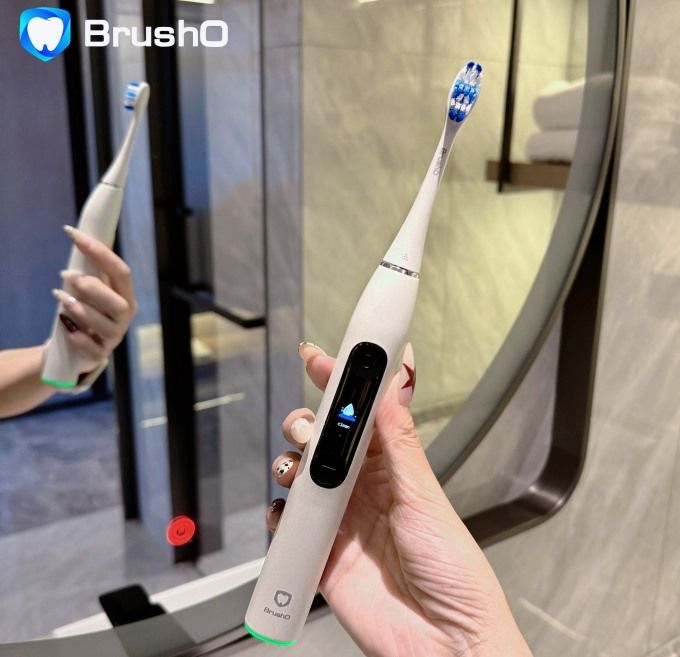
Smart oral‑care tools, such as BrushO, help by tracking brushing pressure, movement, and consistency—reducing unnecessary strain on jaw muscles and preventing inflammation before it escalates.
You should consult a dental professional if:
• Headaches occur regularly without a clear cause
• Pain worsens when chewing or clenching
• You experience jaw stiffness or clicking
• Headaches persist despite lifestyle changes
Early intervention can prevent long‑term discomfort and more serious dental complications.
Yes—dental issues can absolutely cause headaches. From jaw tension and teeth grinding to gum inflammation and poor brushing technique, oral health plays a far greater role in head pain than most people realize. By improving daily brushing habits and paying attention to early warning signs, many recurring headaches can be prevented before they become chronic.
BrushO is an AI‑powered smart toothbrush designed to protect both oral health and daily comfort. By monitoring brushing pressure, coverage, and technique in real time, BrushO helps users reduce jaw strain, prevent gum inflammation, and build healthier habits—supporting not just a cleaner mouth, but a more comfortable, headache‑free lifestyle.

Trigeminal neuralgia (TN), also known as tic douloureux, is a chronic orofacial pain disorder characterized by recurrent, unilateral, brief, electric shock-like pain in the distribution of one or more divisions of the trigeminal nerve. It is widely regarded as one of the most severe pain conditions

Tooth whitening has become one of the most sought-after elective dental procedures worldwide. With increasing emphasis on facial aesthetics, a bright, white smile is now widely perceived as a marker of health, youth, and social confidence. This article provides a comprehensive review of contemporary

The edentulous posterior maxilla presents unique challenges for implant rehabilitation due to the pneumatization of the maxillary sinus and the progressive resorption of the alveolar ridge following tooth loss. Sinus floor elevation, or sinus lift surgery, is a predictable and well-documented surgic

Photodynamic therapy (PDT) is a minimally invasive therapeutic modality that combines a photosensitizing agent, light of a specific wavelength, and molecular oxygen to produce cytotoxic reactive oxygen species. Originally developed for oncological applications, PDT has been increasingly adopted in d

The introduction of temporary anchorage devices (TADs) has fundamentally transformed orthodontic treatment by providing skeletal anchorage that is independent of patient compliance. TADs, also known as mini-implants or miniscrews, enable tooth movements that were previously impossible or required co

Dental caries remains one of the most prevalent chronic diseases worldwide, disproportionately affecting children, elderly populations, and communities with limited access to conventional restorative care. The traditional restorative approach requires expensive equipment, cooperative patients, and m

Platelet-rich fibrin (PRF), a second-generation platelet concentrate, has emerged as one of the most widely adopted autologous biomaterials in contemporary dentistry and oral surgery. Developed by Dr. Joseph Choukroun and colleagues in France in 2001, PRF represents a conceptual evolution from first

The transition from conventional to digital impressions represents one of the most significant technological shifts in contemporary dentistry. Intraoral scanners (IOS) have evolved from experimental prototypes in the 1980s to sophisticated clinical instruments that now rival and, in several key metr

Gingival recession, defined as the apical migration of the gingival margin beyond the cementoenamel junction with exposure of the root surface, is a prevalent condition affecting a substantial proportion of the adult population. Epidemiological studies report that approximately 50% of adults exhibit

Cone beam computed tomography (CBCT) has revolutionized endodontic diagnosis and treatment planning by providing three-dimensional imaging that overcomes the inherent limitations of conventional periapical radiography. While two-dimensional radiographs remain the first-line imaging modality for endo

สร้างเครือข่ายข้อมูลสุขภาพช่องปากอย่างรวดเร็วและต้นทุนต่ำในวิธีที่ทุกคนสามารถสร้างได้


Address: RM 1427, 14/F RADIO CITY 505, HENNESSY RD CAUSEWAY BAY, HONG KONG
Code: 000000
Phone: +852-53758652
Email: customerservice@brusho.com