
Pacifiers can be lifesavers for fussy babies, helping them sleep better and self-soothe. But prolonged or improper use of pacifiers may have long-term effects on your child’s oral development. From misaligned teeth to altered jaw structure, it’s important to understand the dental risks associated with pacifier use—and how to avoid them. This article explores how to protect your baby’s future smile while still using pacifiers safely and mindfully.
Pacifiers mimic the sucking reflex, which is natural and comforting for infants. However, extended use—especially beyond the age of 2—can interfere with natural oral and facial development in ways such as:
• Open bite: A gap between upper and lower teeth, even when the mouth is closed
• Overbite: Upper teeth pushing far beyond the lower teeth
• Crossbite: Misalignment where the upper teeth fit inside the lower teeth
• Changes in palate shape: Narrowing of the upper jaw or high-arched palate
These changes may require orthodontic intervention later if not managed early.
• 0–6 months: Safe and beneficial. Reduces risk of SIDS (Sudden Infant Death Syndrome).
• 6–18 months: Still generally safe, but should start limiting usage to sleep time.
• 18 months–3 years: Risk of dental misalignment increases. Monitor closely.
• After age 3: Strongly advised to wean off. Dental complications become more likely.
Look out for these early red flags:
• Teeth not coming in straight
• Mouth always slightly open, even at rest
• Trouble chewing or speaking sounds clearly
• Receding gums or visible bite issues
Early detection allows for preventive action. Pediatric dentists can evaluate alignment and growth even before all baby teeth erupt.
✅ How to Use Pacifiers Without Harming Dental Development
• Choose orthodontic pacifiers: Designed to minimize pressure on gums and teeth
• Never dip in sweet substances: This can cause early childhood cavities
• Sterilize and replace regularly: Avoid bacterial buildup and material degradation
• Limit usage to bedtime: Avoid “all-day” reliance
• Wean off by age 2–3: Use gradual reduction methods like shortening usage time or offering a comforting toy instead
Although brushing starts later, early oral care routines lay the foundation for a healthy smile. Here’s how:
• Wipe baby’s gums with a soft cloth after feedings to reduce bacterial buildup
• Start brushing when the first tooth appears, using a baby toothbrush
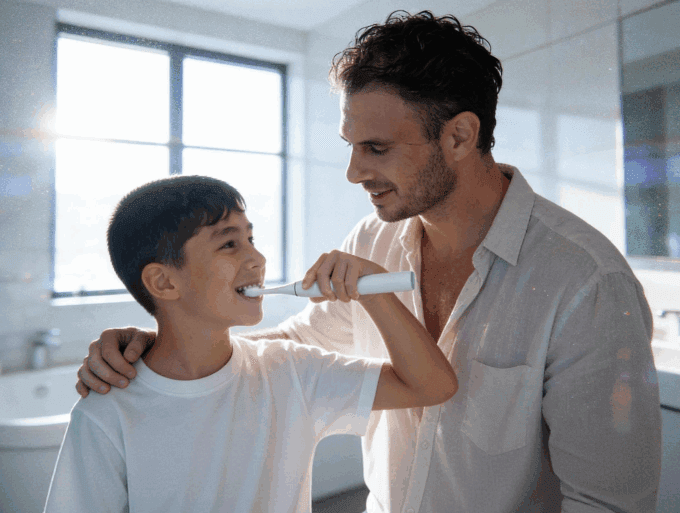
• Switch to a smart toothbrush like BrushO once they’re older to build good brushing habits from the start
BrushO’s child-friendly AI brushing assistant helps guide kids through brushing routines, ensuring they learn correct techniques and avoid common brushing mistakes—supporting healthy smiles for years to come.
Pacifiers are not inherently bad—but how and how long you use them matters. With age-appropriate weaning, careful monitoring, and early dental checkups, you can protect your child’s smile from long-term damage. And when brushing begins, combining those habits with BrushO’s smart brushing system ensures your child develops not just a straight smile, but a healthy one too.
Jan 12
Jan 9

Fluoride in drinking water is the most cost-effective caries preventive measure in public health, and it is also the source of most avoidable fluoride exposure in young children. The balance between benefit and risk depends on concentration, on total intake from all sources and on the age of the ...

A mouthguard is the only piece of protective equipment that a dentist can prescribe, and the difference between the cheapest and the best version is often less than the cost of a single repair. This guide explains what each type of mouthguard actually protects, how to judge fit, and what to check...

Distinguishing reversible from irreversible pulpitis is the single most consequential decision in endodontic diagnosis, because one leads to a restoration and the other to root canal treatment or extraction. The distinction rests on symptoms and pulp testing rather than on radiographs alone, and ...

A pregnancy epulis is a benign overgrowth of gum tissue that appears during pregnancy, most often in the second or third trimester. It can alarm patients because it grows quickly and bleeds easily, yet in most cases it needs no surgery and settles after delivery. Understanding what drives the gro...

When several teeth are missing, the choice usually narrows to a removable partial denture or a fixed implant-supported restoration, and cost is the factor patients raise first. Upfront price is only part of the comparison, because the two options differ in maintenance, comfort, effects on neighbo...

Most root canal failures are not caused by inadequate cleaning of canals that were found, but by canals that were never located. Molar anatomy varies widely, and the variation is not random: specific teeth in specific populations have predictable additional canals. Knowing where they hide is the ...

Gum massage is one of the oldest recommendations in oral care and one of the least understood. It has been described as a treatment for bleeding gums, a route to firmer tissue and, more recently, a way to reduce brushing force. This article separates the mechanisms that are supported by physiolog...

Interdental cleaning is the part of oral hygiene most people abandon first, and the choice between a floss pick and a length of string floss is often made on convenience. Convenience matters, because a tool that is used daily outperforms a superior tool that stays in the drawer, but the two devic...

Dementia changes the way a denture is worn, cleaned and tolerated, and the people who notice the change first are usually family carers rather than clinicians. Poor denture hygiene in this group is associated with mucosal infection, reduced food intake and, in frail patients, respiratory complica...

Chewing tobacco keeps nicotine and plant irritants in prolonged contact with a small area of mucosa, and the damage that results is concentrated exactly where the quid is held. The lesions that develop are often painless, which is why they are discovered during routine examination rather than bec...

สร้างเครือข่ายข้อมูลสุขภาพช่องปากอย่างรวดเร็วและต้นทุนต่ำในวิธีที่ทุกคนสามารถสร้างได้


Address: RM 1427, 14/F RADIO CITY 505, HENNESSY RD CAUSEWAY BAY, HONG KONG
Code: 000000
Phone: +852-53758652
Email: customerservice@brusho.com