
Are you brushing your teeth the right way—or just going through the motions? One of the most overlooked aspects of oral hygiene is the angle at which you hold your toothbrush. Brushing at the wrong angle can miss plaque along the gumline, damage enamel, or cause gum recession. Experts recommend a 45-degree angle for the best results. This simple adjustment can dramatically improve your brushing effectiveness, reduce your risk of gum disease, and keep your smile healthier for longer. In this article, we’ll break down why angle matters, how to brush correctly, and how smart toothbrushes like BrushO can guide you in real-time for perfect brushing form.
The angle at which you hold your toothbrush determines how well you clean both the tooth surface and the gumline. Brushing straight across (90 degrees) may clean the flat surfaces of teeth, but fails to remove plaque nestled along the gums—where gingivitis and periodontitis begin. A 45-degree angle, on the other hand, positions the bristles to sweep beneath the gumline and gently massage the gums, which helps remove debris and bacteria where it matters most.
According to the American Dental Association, the ideal brushing technique is the Bass Technique, which recommends:
• Hold your toothbrush at a 45-degree angle to your gums
• Use short, gentle strokes
• Focus on cleaning the gumline, not just the tooth surface
• Brush each section for several seconds before moving on
This angle allows bristles to reach slightly under the gumline, effectively cleaning the crevice between the gums and teeth where plaque builds up.
Holding your toothbrush at the wrong angle can result in:
• Missed plaque around the gumline
• Gum irritation or recession due to aggressive brushing
• Enamel erosion from brushing flat with too much force
• Ineffective cleaning, even if you brush twice daily
Over time, poor brushing angles can lead to gingivitis, tartar buildup, and even tooth sensitivity.
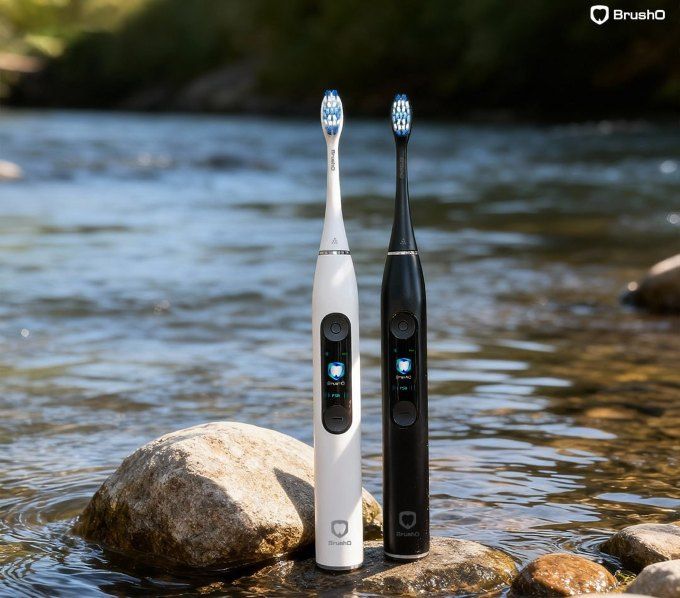
Modern solutions like BrushO, an AI-powered smart toothbrush, solve the problem of improper brushing angle through real-time feedback:
• FSB (Fully Smart Brushing) sensors detect brush angle, pressure, and movement
• The BrushO app provides live coaching and visual cues if you’re brushing incorrectly
• It tracks coverage zones to ensure each part of your mouth gets equal attention
• Personalized tips help you adjust hand position and brushing habits over time
By following on-screen guidance, users naturally learn to hold the toothbrush at the ideal 45-degree angle, reducing the risk of gum disease and improving long-term dental health.
1. Tilt the brush head toward the gumline—not straight into the teeth
2. Relax your grip—too much pressure flattens the bristles
3. Let the bristles do the work—don’t scrub
4. Watch your reflection to stay mindful of angles
5. Use a smart toothbrush with real-time guidance and reminders
Brushing your teeth isn’t just about how often, but how correctly—and the angle is one of the most critical but forgotten details. Holding your toothbrush at the right angle ensures deeper cleaning, protects your enamel, and supports healthier gums. With tools like BrushO, you can stop guessing and start brushing with precision. Let real-time feedback guide your hand to the perfect 45-degree angle—your teeth and gums will thank you.
Dec 30
Dec 30

The xerostomia is the symptom that the patient describes as the dry mouth, and the Sjogren syndrome is the systemic autoimmune condition that the clinician identifies as one of the causes that the symptom reveals. The dry mouth that the patient reports may follow the medication, the radiation, th...

The sinus lift is the augmentation procedure that the clinician performs to create the bone height that the posterior maxilla requires for the implant, and the choice between the lateral window and the transcrestal approach determines the surgical trauma, the healing, and the implant that the sit...

Post-extraction bleeding is one of the most common and most distressing experiences after a tooth extraction. For most patients, a small amount of oozing from the extraction site for 24 to 48 hours after the procedure is completely normal. However, when bleeding becomes excessive, prolonged, or d...

The skeletal class III malocclusion is the condition that the clinician treats with the orthognathic surgery or the camouflage orthodontic treatment, and the decision between the two paths determines the function, the aesthetics, and the stability that the patient receives. The orthognathic surge...

Interproximal enamel reduction — commonly referred to as IPR, slenderizing, stripping, or contouring — is the controlled removal of small amounts of enamel from the proximal surfaces of teeth. Despite sounding more invasive than it is, IPR is one of the most widely used and clinically safe proced...

The gingival graft is the surgical procedure that the periodontist performs to restore the keratinized tissue and to cover the exposed root, and the choice between the free gingival graft and the connective tissue graft determines the outcome that the patient receives. The free gingival graft har...

Denture adhesives — commonly known as fixatives or denture creams — are among the most widely used adjuncts in prosthodontic care. Millions of complete and partial denture wearers use some form of adhesive daily, often without a clear understanding of what these products do, when they should be u...

When a young patient presents with an immature tooth that has lost its vitality — typically due to trauma or deep caries — the endodontist faces one of the most consequential decisions in paediatric endodontics. The permanent root has not finished forming, the apex remains open, and the tooth is ...

The ankyloglossia is the condition that the lingual frenulum restricts the movement of the tongue, and the release of the frenulum in the infant is the procedure that the clinician performs to restore the function that the feeding and the speech require. The assessment that the clinician performs...

Dental amalgam fillings have been in clinical use since the mid-19th century, making them one of the most historically established restorative materials. In 2026, the conversation around amalgam replacement has shifted from a simple material preference debate to a nuanced clinical assessment of w...

สร้างเครือข่ายข้อมูลสุขภาพช่องปากอย่างรวดเร็วและต้นทุนต่ำในวิธีที่ทุกคนสามารถสร้างได้


Address: RM 1427, 14/F RADIO CITY 505, HENNESSY RD CAUSEWAY BAY, HONG KONG
Code: 000000
Phone: +852-53758652
Email: customerservice@brusho.com