
While brushing your teeth is often considered a basic hygiene task, it can also serve as a grounding mental ritual. With AI-guided brushing routines like those offered by BrushO, oral care transforms into a moment of calm and intentionality—helping you reset your mind, reduce cognitive overload, and start your day with focus. This article explores the surprising link between brushing habits and mental clarity, and how you can turn a mundane task into a mindful reset.
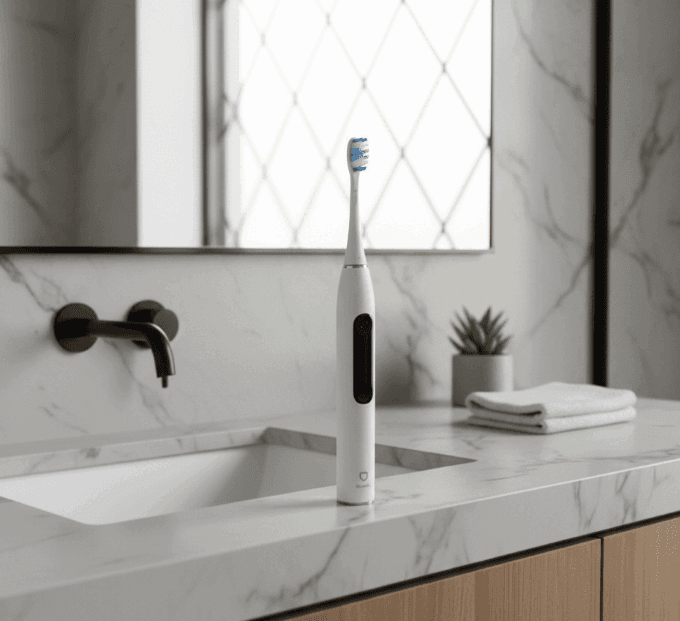
Many of us treat brushing as a mechanical chore—rush it, check it off, and move on. But the act of brushing your teeth is one of the few predictable, screen-free moments in a day filled with digital noise. When done mindfully, it can:
• Signal the start of a new task cycle (morning/evening routine)
• Give your brain a short mental break from multitasking
• Create structured time for stillness and focus
According to behavioral science, micro-routines like brushing can become powerful habit anchors, helping reinforce mental discipline and clarity.
The concept of mindful brushing means staying fully present while brushing—not just with your hands, but with your awareness. This can improve your mental state in several ways:
• Focus Reset: Being intentional about each brushing stroke reduces mental scatter.
• Calming Repetition: The rhythmic, repetitive nature of brushing soothes the nervous system.
• Cognitive Anchor: Brushing marks a clear transition between activities—helpful for task-switching without mental lag.
Even just two minutes of focused brushing can function like a micro-meditation—a stress buffer for your brain.
With BrushO’s AI-powered technology and gamified feedback, brushing becomes a structured and engaging mental routine.
BrushO’s Fully Smart Brushing (FSB) system provides live feedback on pressure, coverage, and duration. Users are naturally more attentive, eliminating “autopilot brushing” and training the mind to stay engaged.
Instead of generic timers, BrushO divides the mouth into 6 zones and 16 surfaces, encouraging users to stay fully focused. You’re constantly aware of which areas are done, which builds attentional control.
By earning $BRUSH tokens for brushing consistently and correctly, users are rewarded for their focus. This not only supports habit formation but also reinforces the brain’s dopamine response to mindful behavior.
The BrushO app visually tracks your brushing streaks and daily scores, reinforcing routine behavior—a key part of cognitive resilience and mental clarity.
You don’t need to overhaul your life to build a mindful brushing routine. Start with small tweaks:
• Leave your phone outside the bathroom
• Focus on the feel and sound of the bristles
• Take 3 deep breaths before starting
• Use smart brushing tools that guide your attention
• Pair brushing with a mental affirmation (e.g., “This is my time to reset”)
Brushing your teeth may seem trivial—but with the right mindset and smart tools, it becomes a mini-meditation, a brain reset, and a mental clarity booster. In a world of constant noise, BrushO offers a two-minute window of peace, discipline, and focus—twice a day, every day.

A narrow alveolar ridge is one of the commonest obstacles to implant placement, and ridge splitting offers an elegant alternative to lengthy guided bone regeneration. The technique divides the deficient ridge into two cortical plates, expands them apart, and places an implant in the gap, so that ...

The inferior alveolar nerve block is the workhorse of mandibular anesthesia, yet it is the injection that fails most often in everyday practice. When the tooth still responds to cold and the patient still feels pain, the clinician faces a familiar dilemma: repeat the block, switch to another tech...

Finding the canal is the first challenge of every endodontic case, and it becomes a serious problem when a pulp chamber has calcified or when a crown obscures the anatomy. Guided endodontics brings the precision of computer-aided planning to this task: a cone-beam computed tomography scan and an ...

The occlusal surfaces of the permanent molars carry deeply invaginated pits and fissures that trap plaque and resist brushing, and it is here that most caries in children begins. Pit and fissure sealants fill these defects with a resin barrier, isolating the enamel from food and bacteria. This ar...

Periodontitis is a biofilm disease, and the primary treatment remains mechanical debridement of the root surfaces and the maintenance of a clean environment. Antibiotics are not a treatment in their own right, but in selected forms of the disease they act as a valuable adjunct, suppressing the su...

Maxillary transverse deficiency is a common problem in adolescent and adult patients, and while rapid palatal expansion works well in the growing child, the mature midpalatal and circummaxillary sutures resist conventional expansion. Surgically assisted rapid palatal expansion, commonly abbreviat...

The position of the screw access channel is the hidden geometry that decides whether a screw-retained implant crown looks natural or fails esthetically. In the anterior zone the access hole must be brought to the lingual or palatal surface; in the posterior zone it can rest on the occlusal table....

The grafting of a deficient ridge was long seen as a mandatory step before implant placement, and classic teaching recommends a bone graft whenever the residual volume is small. In the same period, a simpler philosophy has matured: in a large share of cases, a favorable site can host an implant w...

The premature loss of a primary tooth is a common event in the growing child, and the premature loss of the primary first molar before its successor is ready is a particular problem. The loss of the primary first molar often passes without obvious symptoms, but the consequences for the permanent ...

The gingival biotype describes the thickness and the contour of the gingiva around a tooth or an implant, and it strongly influences the prognosis of every restorative and periodontal procedure. A thin, scalloped biotype is fragile: recession follows minimal trauma, the soft tissue shows through ...

Construa uma rede de dados de saúde bucal rapidamente e com baixo custo de forma que todos possam construir.
Construa uma rede de dados de saúde bucal rapidamente e com baixo custo de forma que todos possam construir.


Address: RM 1427, 14/F RADIO CITY 505, HENNESSY RD CAUSEWAY BAY, HONG KONG
Code: 000000
Phone: +852-53758652
Email: customerservice@brusho.com