
In this post, we’ll explore the signs, consequences, and AI-powered solution, such the BrushO toothbrush, that help protect your smile.
Brushing too hard is one of the most common mistakes people make in their oral care routines. While many think "more pressure = cleaner teeth," the opposite is true. Overbrushing can:
-Erode tooth enamel
-Cause gum recession
-Increase tooth sensitivity
-Lead to long-term oral health issues
This is especially problematic for people using manual toothbrushes or electric toothbrushes without pressure sensors or smart feedback systems.
How can you tell if you're brushing too aggressively? Here are a few red flags:
Your gums appear to be pulling away from your teeth, exposing the root surface.
You feel sharp pain when drinking cold or hot beverages.
If your brush bristles look worn within a few weeks, it's a clear sign of excessive force.
While some bleeding can indicate gingivitis, brushing too hard can also be the culprit.
This is where AI-powered electric toothbrushes come in.
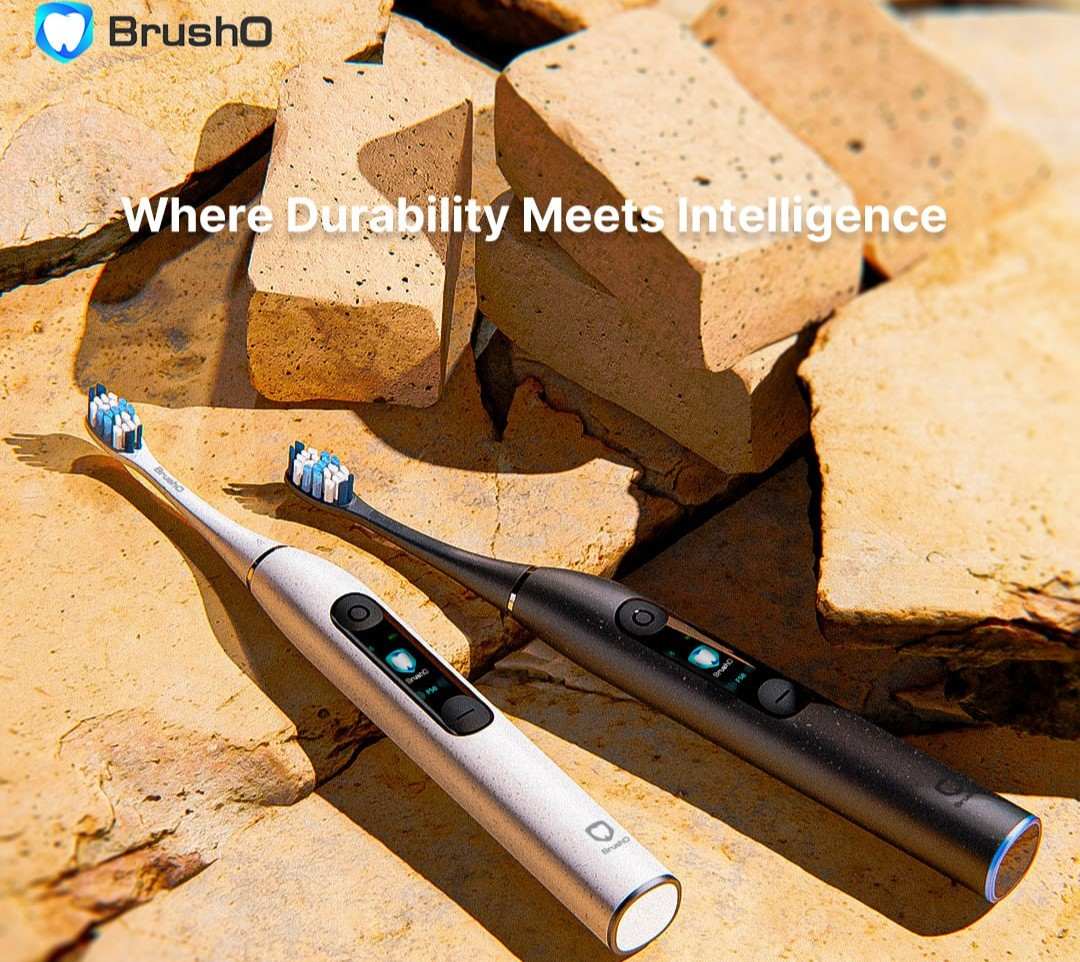
AI toothbrushes like BrushO are equipped with 6-axis sensors and smart pressure detection, providing real-time feedback if you’re pressing too hard.
The BrushO app monitors six mouth zones and 16 surface areas, helping you brush evenly and gently.
Receive daily/weekly/monthly brushing reports to track pressure, duration, and coverage—adjusting your technique over time.
The BrushO AI-powered electric toothbrush is designed to protect your enamel and gums:
AI-powered feedback prevents overbrushing
Gum-friendly DuPont bristles
Pressure-sensing vibration control
45-day battery life, Qi wireless charging
Decentralized data storage: Your brushing data is 100% yours
💡 BrushO is especially recommended for users with sensitive gums or gum recession concerns.
Here are some how-to tips to avoid brushing too hard:
If you're using an electric toothbrush, guide it along the gumline instead of scrubbing.
Old, worn-out bristles are ineffective and tempt you to apply more pressure.
BrushO includes a built-in smart timer that helps you brush each zone for the correct duration.
Brushing hard doesn’t mean brushing better. In fact, it can cause long-term damage. With the help of smart solutions like the BrushO toothbrush, you can maintain optimal oral hygiene gently and effectively.
If you're looking for a gentle, intelligent, and gum-friendly electric toothbrush, BrushO might be exactly what you need.

Water that leaves a dental unit is not sterile, and it has not been sterile for decades. The narrow tubing that carries coolant to the handpiece and the air-water syringe provides an ideal surface for a biofilm that sheds organisms into every patient's mouth. Sterilisation of the instruments does...

A young adult presents with soreness of the gums, and the examination shows a striking change that is easily mistaken for severe periodontal disease: the mucosa is thickened, folded and studded with tiny yellow pustules that rupture to leave shallow ulcers resembling snail tracks. This is pyostom...

A patient who becomes cyanosed minutes after an apparently routine infiltration, yet keeps talking and breathing comfortably, presents a diagnostic trap. The saturation monitor reads in the eighties, supplemental oxygen changes nothing, and the chest sounds clear. This is the classic signature of...

Most patients with clicking, locking and jaw pain improve with reassurance, soft diet, splint therapy and physical measures. A minority do not, and their imaging shows a displaced disc with degenerative change, a shortened condyle or a persistent closed lock. For that group, two operations compet...

A slowly growing palatal swelling that the patient has noticed for two years, a minor salivary gland tumor that looks deceptively well demarcated, and a nerve that carries tumor cells far beyond the visible mass: this is the natural history of adenoid cystic carcinoma. It is uncommon, it is rarel...

Saliva is easy to overlook until its volume changes. An excess produces drooling that soils clothing and isolates a patient socially, while a painless enlargement of both parotid glands raises the question of systemic disease. Sialorrhea and sialadenosis sit at opposite ends of the same physiolog...

When caries in a primary molar reaches the pulp but the tooth can still be restored and the supporting bone is intact, pulpectomy offers a way to keep the tooth comfortable and functional until exfoliation. The procedure removes both the coronal and the radicular pulp and replaces it with a resor...

Disorders of the fibroblast growth factor receptor genes produce some of the most distinctive facial appearances in medicine, and the two extremes are instructive. Pfeiffer syndrome allows survival with staged craniofacial surgery, while thanatophoric dysplasia is almost always lethal in the neon...

A panoramic radiograph that shows a uniformly dense mandible or maxilla can indicate an entirely benign finding, such as a dense bone island or a torus, or it can be the first clue to a generalized skeletal disorder. Osteopetrosis and the broader group of osteosclerotic conditions differ greatly ...

A patient who cannot open the mouth more than a finger breadth, yet whose temporomandibular joint still moves on imaging, presents one of the most easily misdiagnosed problems in oral surgery. The restriction in such cases lies outside the joint, and the condition is termed pseudoankylosis. An el...

สร้างเครือข่ายข้อมูลสุขภาพช่องปากอย่างรวดเร็วและต้นทุนต่ำในวิธีที่ทุกคนสามารถสร้างได้


Address: RM 1427, 14/F RADIO CITY 505, HENNESSY RD CAUSEWAY BAY, HONG KONG
Code: 000000
Phone: +852-53758652
Email: customerservice@brusho.com