
Brushing your teeth is not just about frequency or duration — angle and positioning play a critical role in protecting enamel, preventing gum recession, and removing plaque effectively. Scientific dental research shows that improper brush angles can leave harmful biofilm behind or cause mechanical damage to soft tissue and tooth surfaces. Understanding the biomechanics of brushing angles allows individuals to improve technique, reduce oral health risks, and maintain long-term dental stability. This article examines the dental science behind optimal brush positioning and how modern smart brushing technology enhances both precision and protection.
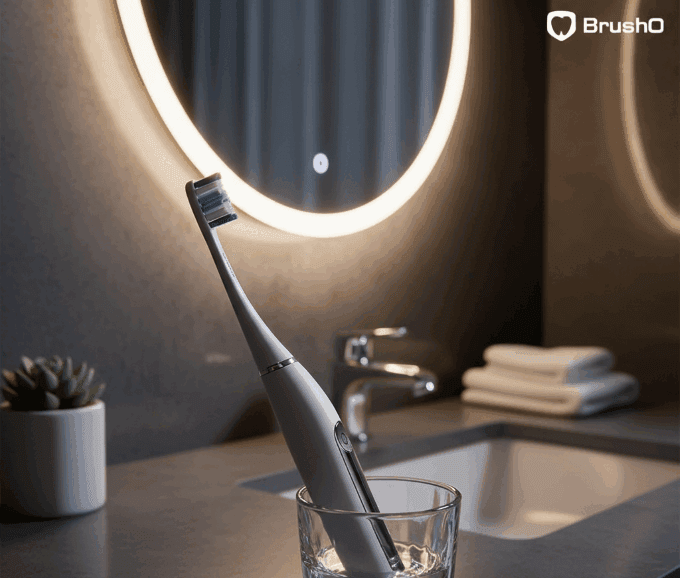
Tooth surfaces are not flat, and plaque accumulates most heavily along the gumline and in microscopic grooves. The angle of toothbrush bristles determines:
• Plaque removal efficiency
• Gumline cleaning coverage
• Pressure distribution
• Enamel wear risk
Incorrect angles can either fail to reach plaque-prone areas or concentrate force in ways that damage teeth and gums.
Dentists consistently emphasize technique because mechanical biofilm disruption — not toothpaste alone — drives effective cleaning outcomes.
Clinical dental guidance widely supports holding the toothbrush at roughly a 45-degree angle toward the gumline.
This positioning:
• Allows bristles to enter the sulcus (gum margin)
• Removes plaque before inflammation begins
• Protects connective tissue attachment
• Improves coverage along tooth contours
Gentle vibrating or circular motions further enhance bacterial disruption without excessive abrasion.
For inner tooth surfaces, especially lower incisors:
• A vertical brush position
• Upward or downward rolling strokes
provides better access to narrow anatomical areas where plaque often hardens quickly.
Molars benefit from:
• A flatter brush angle
• Short controlled strokes
to clean fissures where food particles accumulate.
Brushing horizontally with excessive pressure concentrates friction on enamel surfaces, accelerating wear.
Improper angles combined with force can traumatize the gingival tissue, exposing the tooth roots and increasing sensitivity.
Angles that avoid the gumline leave bacteria undisturbed, allowing biofilm maturation and disease progression.
Over time, technique errors can outweigh brushing frequency in determining oral health outcomes.
Tooth protection relies on balancing mechanical cleaning and tissue preservation.
Effective brushing angles:
• Distribute force evenly
• Maximize bristle contact area
• Reduce localized abrasion
• Reach bacterial reservoirs
This biomechanical balance explains why trained technique correlates strongly with lower periodontal risk.
Maintaining ideal brushing angles manually can be difficult, particularly for hard-to-see zones.
AI-enabled tools like BrushO improve consistency by:
• Tracking brush orientation and movement patterns
• Monitoring coverage across 6 zones and 16 surfaces
• Detecting technique irregularities
• Providing performance reports after each session
• Reinforcing proper habits through feedback and rewards
By translating brushing mechanics into measurable data, smart brushing minimizes user error and supports long-term tooth protection.
Dentist-backed strategies include:
• Dividing the mouth into zones
• Maintaining relaxed grip pressure
• Spending balanced time per region
• Checking coverage symmetry
• Using guided brushing tools
Habit awareness combined with technique feedback significantly improves plaque removal outcomes.
The science of brushing angle highlights an often-overlooked truth: how you brush matters as much as how often you brush. Correct positioning protects enamel, preserves gum health, and maximizes plaque removal efficiency. Improper angles can accelerate wear, inflammation, and long-term dental deterioration. Understanding brushing biomechanics — and leveraging precision tools like BrushO — transforms oral care from routine repetition into targeted protection. When angle, pressure, and coverage align, brushing becomes a proactive strategy for lifelong tooth preservation.
Feb 11
Feb 11

Hyperdontia is the presence of one or more teeth in excess of the normal dental formula, and the resulting teeth are described as supernumerary. The condition is common enough to appear in routine practice but variable enough in presentation that the decision to intervene is rarely straightforwar...

Few patients complete orthodontic treatment without asking whether their teeth will move back. The honest answer is that they will, to some degree, in the majority of cases. Relapse is not a failure of treatment but a predictable biological response, and understanding why it happens is the basis ...

The mandible is the largest and most frequently fractured bone of the facial skeleton, and its management sits at the interface between trauma surgery and restorative dentistry. Treatment has shifted over four decades from prolonged maxillomandibular fixation towards rigid internal fixation with ...

Chronic liver disease affects hundreds of millions of people worldwide, and its prevalence continues to rise with the epidemic of metabolic liver disease. The liver is central to haemostasis, drug metabolism and immune competence, and its failure therefore alters the risk profile of almost every ...

Excessive gingival display, commonly described as a gummy smile, is one of the most frequent aesthetic concerns presented to dental practitioners. The condition is not a single entity but a clinical presentation that can arise from skeletal, gingival, muscular or dental factors, and the treatment...

Drug-induced gingival overgrowth is a well-recognised adverse effect of several widely prescribed medications, and it remains one of the most common drug-related findings in periodontal practice. The condition produces firm, fibrous enlargement of the gingiva that can interfere with speech, masti...

Denture stomatitis is an inflammatory condition of the denture-bearing mucosa that affects a large proportion of removable prosthesis wearers, yet it is frequently dismissed as a cosmetic annoyance. The condition is driven by a Candida biofilm on the fitting surface of the prosthesis, and it is m...

Chronic kidney disease affects an estimated 850 million people worldwide, and the number of patients surviving on dialysis or with a renal transplant continues to rise. These patients carry an oral disease burden that is substantially higher than that of the general population, and their medical ...

Angular cheilitis is an inflammatory lesion of the labial commissures that presents with erythema, fissuring and crusting at the corners of the mouth. It is one of the most common conditions encountered in general dental practice, yet it is frequently treated as a simple fungal infection and allo...

Adverse reactions to dental materials are uncommon but they are not rare, and they are frequently misdiagnosed because the oral mucosa responds to allergens in a limited number of ways. A burning sensation, a persistent ulcer or an unexplained area of erythema may all represent a hypersensitivity...

Xây dựng mạng dữ liệu sức khỏe răng miệng nhanh chóng và chi phí thấp theo cách mọi người đều có thể tham gia.
Xây dựng mạng dữ liệu sức khỏe răng miệng nhanh chóng và chi phí thấp theo cách mọi người đều có thể tham gia.


Address: RM 1427, 14/F RADIO CITY 505, HENNESSY RD CAUSEWAY BAY, HONG KONG
Code: 000000
Phone: +852-53758652
Email: customerservice@brusho.com