
Flavored water is widely marketed as a healthier alternative to soda, often perceived as harmless to oral health. However, wide varieties contain acids, sweeteners, and flavoring compounds that significantly lower oral pH and promote enamel erosion. Because flavored water is consumed frequently throughout the day, exposure duration may exceed that of traditional soft drinks. This prolonged acidic contact accelerates mineral loss, increases sensitivity risk, and weakens tooth surfaces over time. Understanding the chemistry behind beverage acidity and adopting strategic oral care practices allows consumers to make informed hydration choices while preserving enamel integrity.
Flavored water is commonly associated with wellness and hydration. However, many formulations contain:
• Citric acid
• Malic acid
• Phosphoric acid
• Artificial flavor stabilizers
• Sweeteners
These ingredients create a low-pH environment similar to or more persistent than soda, particularly when consumed frequently. Unlike soda, which is often consumed in single servings, flavored water is sipped continuously — extending enamel exposure time.
Tooth enamel begins to weaken when oral pH drops below critical thresholds. Acidic beverages dissolve protective minerals, making teeth vulnerable to:
• Sensitivity
• Surface roughness
• Structural thinning
Frequent sipping throughout the day:
• Prevents saliva from neutralizing acids
• Extends erosion windows
• Reduces remineralization opportunities
This behavioral pattern often makes flavored water more damaging over time than occasional soda consumption.
Some flavored waters include added sugars or fermentable sweeteners that:
• Feed acid-producing bacteria
• Increase plaque formation
• Elevate cavity risk
Even sugar-free versions remain erosive due to acidity.
• Increased temperature sensitivity
• Teeth appearing translucent
• Rough enamel texture
• Yellowing due to dentin exposure
• Gumline vulnerability
Detection at early stages enables preventive intervention.
• Limit continuous sipping
• Drink through a straw
• Consume alongside meals
• Choose plain water when possible
• Rinse with water afterward
• Stimulate saliva production
• Maintain hydration balance
Wait 30–60 minutes after acidic beverage consumption to avoid brushing softened enamel.
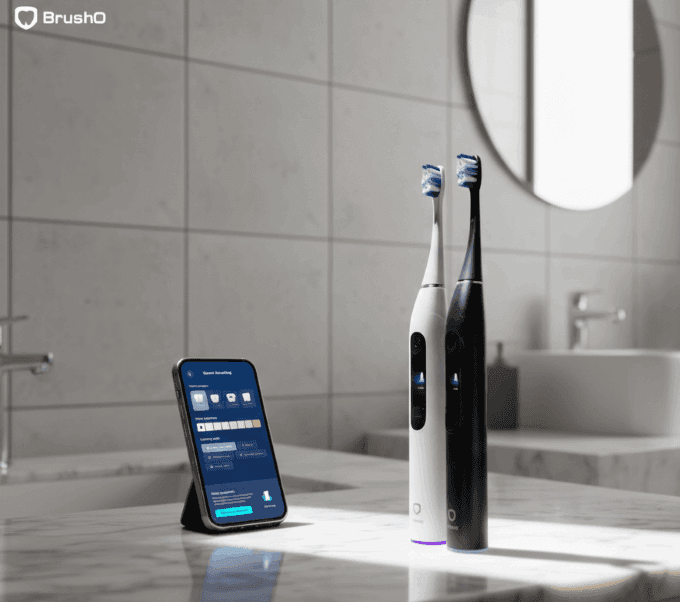
Advanced tools such as BrushO AI smart brushing enhance protection through:
• Pressure regulation reducing abrasion
• Zone mapping ensuring plaque removal
• Adaptive modes for enamel sensitivity
• Habit tracking improves routine consistency
Technology-driven brushing helps counteract lifestyle-based acid exposure.
Modern beverage trends emphasize flavor and convenience, often overlooking oral chemistry impacts.
Protecting enamel today requires:
• Awareness of acidity sources
• Behavioral adjustments
• Guided oral hygiene support
This integrated approach preserves long-term dental resilience.
Flavored water’s health halo can obscure its dental risks. Hidden acids combined with frequent consumption may contribute to enamel erosion more significantly than occasional soda intake. By moderating exposure patterns, rinsing appropriately, delaying brushing, and using precision brushing technologies like BrushO, individuals can maintain hydration habits without compromising oral health. Informed choices ensure wellness extends beyond marketing perception to measurable dental protection.
Feb 6
Feb 6

Squamous cell carcinoma is not a single, uniform disease, and two of its oral variants illustrate the extremes of its behavior. Verrucous carcinoma is a slow-growing, exophytic tumor that almost never metastasizes, while spindle cell carcinoma is an aggressive, sarcomatoid malignancy that can be ...

Most people expect a toothache to be the first sign of pulp disease, but some forms of pulpitis are surprisingly silent. A pulp polyp is the visible result of chronic hyperplastic pulpitis, a condition in which the dental pulp grows out of a large carious opening as a fleshy mass. Recognizing thi...

Dry mouth is not merely uncomfortable; it is a medical condition with real consequences for teeth, speech, swallowing and quality of life. When the salivary glands cannot produce enough saliva, medications called sialogogues can restore some of the missing fluid. Pilocarpine and cevimeline are th...

A blister in the mouth can be the first warning of a systemic autoimmune disease, and two disorders deserve particular attention in the dental chair: pemphigus vulgaris and mucous membrane pemphigoid. Both produce chronic oral ulceration, yet their immunologic targets, clinical behavior and long-...

When infection drains from a tooth, the body often creates a visible escape route, and the dentist must interpret these fistulous openings correctly. A parulis is the common gum boil that signals chronic periapical infection, while an oroantral fistula is a communication between the mouth and the...

Among the fibro-osseous lesions of the jaws, the ossifying fibroma holds a unique position because it is a true neoplasm, unlike the reactive cemento-osseous dysplasia discussed in an earlier article. It grows continuously, expands bone and requires surgical removal, and its cemental variant adds...

Not all keratocystic lesions of the jaw behave alike, and one of the most important distinctions in oral pathology separates the orthokeratinized odontogenic cyst from its better-known relative, the odontogenic keratocyst. Although the two lesions look similar under the microscope at first glance...

Periodontal disease is usually a slowly progressive infection, but a rare form called necrotizing ulcerative periodontitis destroys tissue with alarming speed. Unlike ordinary periodontitis, this condition produces necrotic, cratered papillae, deep pocketing and rapid bone loss, and it appears al...

Every parent has met the child who refuses to eat because of painful mouth sores, and most of these children have one of two viral illnesses: herpangina or hand, foot and mouth disease. Both are caused by enteroviruses, both produce fever and oral ulcers, and both are overwhelmingly common in you...

Cementoosseous dysplasia is one of the most common fibro-osseous lesions found on dental radiographs, yet it is also one of the most frequently misdiagnosed. The lesion replaces normal bone with cellular fibrous tissue and cementum-like material, and it appears in several forms that range from a ...

Xây dựng mạng dữ liệu sức khỏe răng miệng nhanh chóng và chi phí thấp theo cách mọi người đều có thể tham gia.
Xây dựng mạng dữ liệu sức khỏe răng miệng nhanh chóng và chi phí thấp theo cách mọi người đều có thể tham gia.


Address: RM 1427, 14/F RADIO CITY 505, HENNESSY RD CAUSEWAY BAY, HONG KONG
Code: 000000
Phone: +852-53758652
Email: customerservice@brusho.com