
Not sure when to toss your old toothbrush? You’re not alone. Worn-out bristles, bacteria buildup, and decreased cleaning power could all mean it’s time for a replacement. In this post, we’ll help you recognize the signs your toothbrush is too old—and show how BrushO’s AI-powered tracking and lifetime free brush head program make replacements easy.
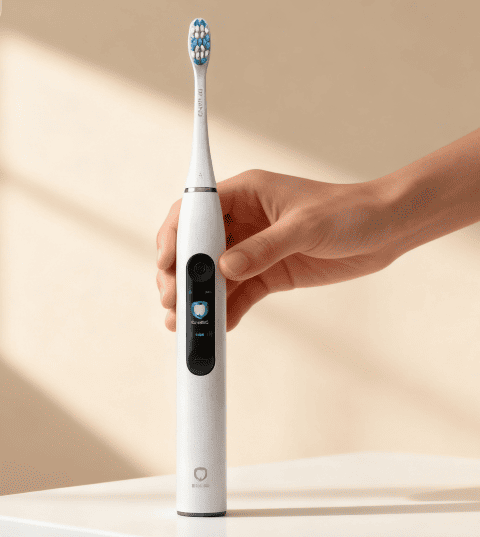
Your toothbrush is the frontline tool in maintaining oral hygiene. But over time, even the best toothbrush—manual or electric—loses its effectiveness. Old toothbrushes can harbor bacteria, lose their cleaning power, and even harm your gums. So, how do you know when it’s time to replace your brush head?
This is the most obvious sign. Worn bristles can’t clean your teeth properly and may irritate your gums. If you notice the bristles have lost their original shape, it’s time for a replacement.
Dentists recommend replacing your toothbrush or brush head every 3 months. After this period, bristles lose effectiveness and bacteria begin to accumulate.
If brushing doesn’t leave your mouth feeling as fresh or clean as before, it could be because the bristles aren’t reaching plaque and debris as effectively.
After an illness, it’s smart to change your brush head. Germs can linger on bristles and potentially lead to reinfection.
Using an old toothbrush can lead to:
-Increased plaque buildup
-Bad breath
-Gum irritation or recession
-Less effective fluoride delivery from toothpaste
-Risk of bacteria or fungal contamination
BrushO isn’t just a smart toothbrush—it’s a brushing partner. With AI-powered usage tracking, BrushO monitors your brushing frequency, pressure, and duration. When it detects your brush head is due for a change, it reminds you directly in the app or via smart alerts.
And here’s the game-changer:
That’s right. As part of the BrushO Reward System, you can earn points by maintaining healthy brushing habits. Once you’ve earned enough points, you can redeem them for free brush heads—forever. This disrupts the traditional model of toothbrush companies profiting from expensive refills.
📌 BrushO’s lifetime brush head plan requires consistent daily brushing to earn points and qualify for free redemptions.
Use a calendar app or your phone’s reminder system. Or better—let BrushO handle this for you automatically.
Always have at least one new brush head on hand, so you can switch as soon as needed.
Your oral health is too important to rely on worn-out tools. Replacing your toothbrush—or better, switching to a smart solution like BrushO—ensures your brushing is always effective, hygienic, and safe. With BrushO’s AI-powered tracking and free lifetime brush head plan, you’ll never worry about brushing with an old toothbrush again.
Nov 3
Nov 3

Squamous cell carcinoma is not a single, uniform disease, and two of its oral variants illustrate the extremes of its behavior. Verrucous carcinoma is a slow-growing, exophytic tumor that almost never metastasizes, while spindle cell carcinoma is an aggressive, sarcomatoid malignancy that can be ...

Most people expect a toothache to be the first sign of pulp disease, but some forms of pulpitis are surprisingly silent. A pulp polyp is the visible result of chronic hyperplastic pulpitis, a condition in which the dental pulp grows out of a large carious opening as a fleshy mass. Recognizing thi...

Dry mouth is not merely uncomfortable; it is a medical condition with real consequences for teeth, speech, swallowing and quality of life. When the salivary glands cannot produce enough saliva, medications called sialogogues can restore some of the missing fluid. Pilocarpine and cevimeline are th...

A blister in the mouth can be the first warning of a systemic autoimmune disease, and two disorders deserve particular attention in the dental chair: pemphigus vulgaris and mucous membrane pemphigoid. Both produce chronic oral ulceration, yet their immunologic targets, clinical behavior and long-...

When infection drains from a tooth, the body often creates a visible escape route, and the dentist must interpret these fistulous openings correctly. A parulis is the common gum boil that signals chronic periapical infection, while an oroantral fistula is a communication between the mouth and the...

Among the fibro-osseous lesions of the jaws, the ossifying fibroma holds a unique position because it is a true neoplasm, unlike the reactive cemento-osseous dysplasia discussed in an earlier article. It grows continuously, expands bone and requires surgical removal, and its cemental variant adds...

Not all keratocystic lesions of the jaw behave alike, and one of the most important distinctions in oral pathology separates the orthokeratinized odontogenic cyst from its better-known relative, the odontogenic keratocyst. Although the two lesions look similar under the microscope at first glance...

Periodontal disease is usually a slowly progressive infection, but a rare form called necrotizing ulcerative periodontitis destroys tissue with alarming speed. Unlike ordinary periodontitis, this condition produces necrotic, cratered papillae, deep pocketing and rapid bone loss, and it appears al...

Every parent has met the child who refuses to eat because of painful mouth sores, and most of these children have one of two viral illnesses: herpangina or hand, foot and mouth disease. Both are caused by enteroviruses, both produce fever and oral ulcers, and both are overwhelmingly common in you...

Cementoosseous dysplasia is one of the most common fibro-osseous lesions found on dental radiographs, yet it is also one of the most frequently misdiagnosed. The lesion replaces normal bone with cellular fibrous tissue and cementum-like material, and it appears in several forms that range from a ...

Costruire rapidamente e a basso costo una rete di dati sulla salute orale in modo che tutti possano creare.
Costruire rapidamente e a basso costo una rete di dati sulla salute orale in modo che tutti possano creare.


Address: RM 1427, 14/F RADIO CITY 505, HENNESSY RD CAUSEWAY BAY, HONG KONG
Code: 000000
Phone: +852-53758652
Email: customerservice@brusho.com