
In a world where almost everything is connected—your phone, your watch, even your fridge—it’s no surprise that toothbrushes are joining the smart tech revolution. A toothbrush paired with an app isn’t just a flashy upgrade—it’s a smarter way to build lasting oral care habits, improve brushing precision, and stay accountable to your dental health. With features like real-time feedback, brushing maps, and habit trackers, the right toothbrush app can help you brush better, longer, and more consistently. Here’s why your next toothbrush should absolutely come with an app—and how BrushO is leading the charge in turning daily dental routines into powerful health tools.
Let’s face it—most people aren’t brushing perfectly. Whether it’s uneven coverage, using too much pressure, or rushing through the routine, manual and even basic electric toothbrushes can’t correct these mistakes. Without visibility into our brushing habits, we’re left guessing if we’re doing enough—and often, we’re not.
Smart toothbrush apps fill this gap. They don’t just track how long you brush—they analyze where, how hard, and how effectively you clean your teeth. It’s a personalized brushing coach in your pocket.
One of the most powerful benefits of a toothbrush app is real-time feedback. BrushO’s app connects instantly with the toothbrush to track your brushing session in detail:
• Pressure alerts: Too much pressure? It warns you instantly to protect your gums.
• Coverage tracking: Missed a zone? The app highlights it so you can go back.
• Timer & guidance: Brush the right zones for the right time, guided gently by visuals and smart prompts.
These insights build better brushing habits by correcting small mistakes in the moment—before they turn into dental problems.
Over time, smart apps generate personalized brushing data: charts, graphs, and trends that show your progress. With BrushO, you can view:
• Daily/weekly/monthly brushing scores
• Zone-specific brushing heatmaps
• Pressure consistency over time
• Brush head replacement reminders
This turns brushing into a measurable, goal-driven activity. Like tracking steps or calories, it gives a sense of accomplishment and encourages consistency.
BrushO’s companion app is designed with usability and motivation in mind. It includes:
• Custom mode settings (e.g., sensitive gums, whitening, deep clean)
• Personalized reminders to brush, change heads, or share data with your dentist
• Lifetime brushing reports for long-term tracking
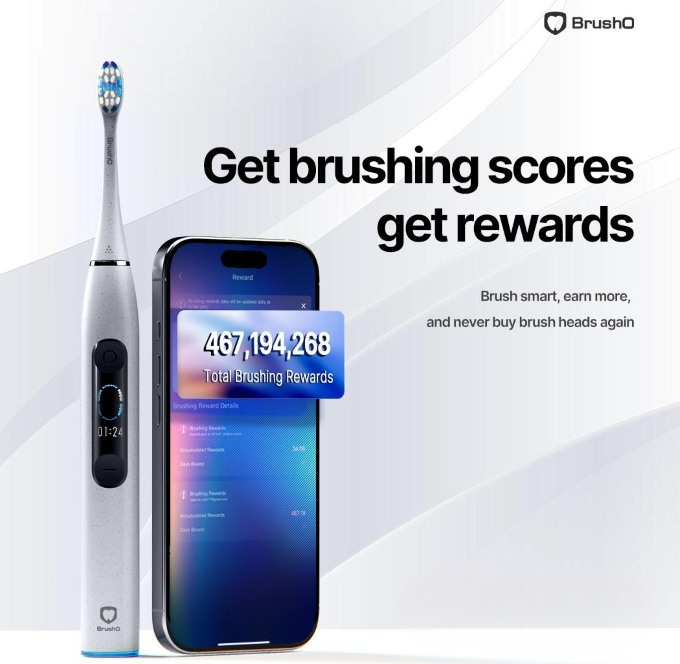
• Points and rewards system (“Brush & Earn”) to encourage consistent brushing
It’s not just data—it’s a system that helps you act on it.
With privacy concerns rising, BrushO is also built differently. Unlike many health apps, BrushO is built on a Web3 foundation that gives you full ownership of your brushing data. Want to share it with your dentist? You choose. Want to keep it private? That’s your right. BrushO believes that your health data belongs to you.
BrushO’s app isn’t just about performance—it’s also part of a sustainability strategy. The app reminds users when to replace brush heads, and with the lifetime free refill program, it reduces plastic waste while saving you money.
Combined with the app, this makes oral care not only smarter but more eco-friendly.
Choosing a toothbrush with an app like BrushO isn’t just about convenience—it’s about accountability, precision, and progress.
You get real-time coaching, data-driven habits, and long-term motivation in one sleek package. In an age where every health decision is becoming smarter and more personalized, your toothbrush shouldn’t be left behind.

Squamous cell carcinoma is not a single, uniform disease, and two of its oral variants illustrate the extremes of its behavior. Verrucous carcinoma is a slow-growing, exophytic tumor that almost never metastasizes, while spindle cell carcinoma is an aggressive, sarcomatoid malignancy that can be ...

Most people expect a toothache to be the first sign of pulp disease, but some forms of pulpitis are surprisingly silent. A pulp polyp is the visible result of chronic hyperplastic pulpitis, a condition in which the dental pulp grows out of a large carious opening as a fleshy mass. Recognizing thi...

Dry mouth is not merely uncomfortable; it is a medical condition with real consequences for teeth, speech, swallowing and quality of life. When the salivary glands cannot produce enough saliva, medications called sialogogues can restore some of the missing fluid. Pilocarpine and cevimeline are th...

A blister in the mouth can be the first warning of a systemic autoimmune disease, and two disorders deserve particular attention in the dental chair: pemphigus vulgaris and mucous membrane pemphigoid. Both produce chronic oral ulceration, yet their immunologic targets, clinical behavior and long-...

When infection drains from a tooth, the body often creates a visible escape route, and the dentist must interpret these fistulous openings correctly. A parulis is the common gum boil that signals chronic periapical infection, while an oroantral fistula is a communication between the mouth and the...

Among the fibro-osseous lesions of the jaws, the ossifying fibroma holds a unique position because it is a true neoplasm, unlike the reactive cemento-osseous dysplasia discussed in an earlier article. It grows continuously, expands bone and requires surgical removal, and its cemental variant adds...

Not all keratocystic lesions of the jaw behave alike, and one of the most important distinctions in oral pathology separates the orthokeratinized odontogenic cyst from its better-known relative, the odontogenic keratocyst. Although the two lesions look similar under the microscope at first glance...

Periodontal disease is usually a slowly progressive infection, but a rare form called necrotizing ulcerative periodontitis destroys tissue with alarming speed. Unlike ordinary periodontitis, this condition produces necrotic, cratered papillae, deep pocketing and rapid bone loss, and it appears al...

Every parent has met the child who refuses to eat because of painful mouth sores, and most of these children have one of two viral illnesses: herpangina or hand, foot and mouth disease. Both are caused by enteroviruses, both produce fever and oral ulcers, and both are overwhelmingly common in you...

Cementoosseous dysplasia is one of the most common fibro-osseous lesions found on dental radiographs, yet it is also one of the most frequently misdiagnosed. The lesion replaces normal bone with cellular fibrous tissue and cementum-like material, and it appears in several forms that range from a ...

সবাই যেন নিজের মতো করে গড়তে পারে – এমনভাবে দ্রুত ও কম খরচে ওরাল হেলথ ডেটা নেটওয়ার্ক তৈরি করুন।
সবাই যেন নিজের মতো করে গড়তে পারে – এমনভাবে দ্রুত ও কম খরচে ওরাল হেলথ ডেটা নেটওয়ার্ক তৈরি করুন।


Address: RM 1427, 14/F RADIO CITY 505, HENNESSY RD CAUSEWAY BAY, HONG KONG
Code: 000000
Phone: +852-53758652
Email: customerservice@brusho.com